In western Ukraine, injured soldiers battle the urge – and the odds – to return to the front line.
Lviv, Ukraine – Vladyslav’s patience is wearing thin. It has been six months since the 29-year-old was admitted to a hospital in the western Ukrainian city of Lviv. His legs are immobilised, he can only move his arms with difficulty, and he is simmering with frustration at his inability to be back at the front.
“Imagine, I’ve been here since March and I cannot walk,” he says with exasperation.Affable and full of wisecracks, Vladyslav cuts an imposing figure even while lying on a couch for his physiotherapy session.
“Everybody thinks you can be prepared for war, but it doesn’t work this way. You just do it. You just act,” he says.
A tank driver in active service in the Ukrainian armed forces since 2009, Vladyslav* was heavily wounded on March 2 in Chernihiv, northern Ukraine. “They failed to capture Chernihiv, so they just tried to destroy it completely,” Vladyslav says.
A missile fell close to the tank he was in, causing serious trauma to his brain. The doctors who rushed to save his life extracted multiple pieces of shrapnel from his head.
As he speaks, Vladyslav’s left leg jerks intermittently – a grim reminder of the serious damage done to his nervous system. Later, he was transferred to a hospital in Lviv that treats a large proportion of soldiers.

Vladyslav’s eagerness to rejoin his comrades is tinged with anger. He was born and grew up in Luhansk. When, in 2014, pro-Russian unrest rippled across Donbas, as the regions of Luhansk and Donetsk are collectively known, his family fled northwest to Severodonetsk. “Our apartment was seized by separatists,” he says.
When Russia’s full-scale invasion began on February 24, his family was forced to abandon Severodonetsk and seek refuge in the capital Kyiv.
After months in hospital, Vladyslav says it is unthinkable for him to give up on the war effort. “Of course, I want to go back to the front line,” he laughs. “I’m a very good tank driver. Some people decide to leave the country and not defend it, but I was not raised in this way.”
For now, the hospital is unable to ascertain how long Vladyslav’s recovery will take, or if he will regain the use of his legs.
Race to heal soldiers
As the war nears its seventh month, the experiences of injured soldiers like Vladyslav paint a picture of the brutal consequences of prolonged fighting as injuries and deaths rise rapidly amidst widespread exhaustion.
In the relative safety of western Ukraine, hospitals are struggling to treat hundreds of soldiers like Vladyslav. Many of these soldiers have suffered critical wounds and are not physically or mentally ready to return to the front line, but feel an immense need to do so.
Medical staff are racing against the clock to heal those who – once deemed fit – will return to the front lines.
Ukraine was initially outnumbered seven to one in terms of soldiers at the beginning of the war. But with a powerful boost from weapons and equipment supplied by 28 countries, since September, its military has launched an unexpectedly rapid counter-offensive that reclaimed key cities in the east and south of the country, including in the Kharkiv and Kherson regions. Still, experts predict the war will stretch into next year.
The latest official figures from Ukraine report that 9,000 soldiers have been killed in action since the beginning of the war, and government estimates from early June stated that some 100 to 200 are killed every day, with a further 500 wounded in action.
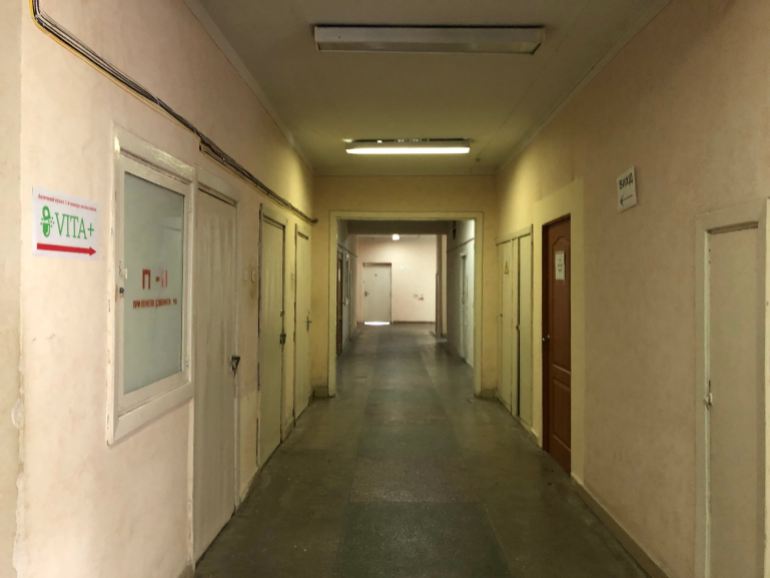
At the hospital where Vladyslav is receiving treatment, many of the common areas are dark and the odd indoor plant droops on the wall. Where there are windows, natural light filters in weakly through lace curtains.
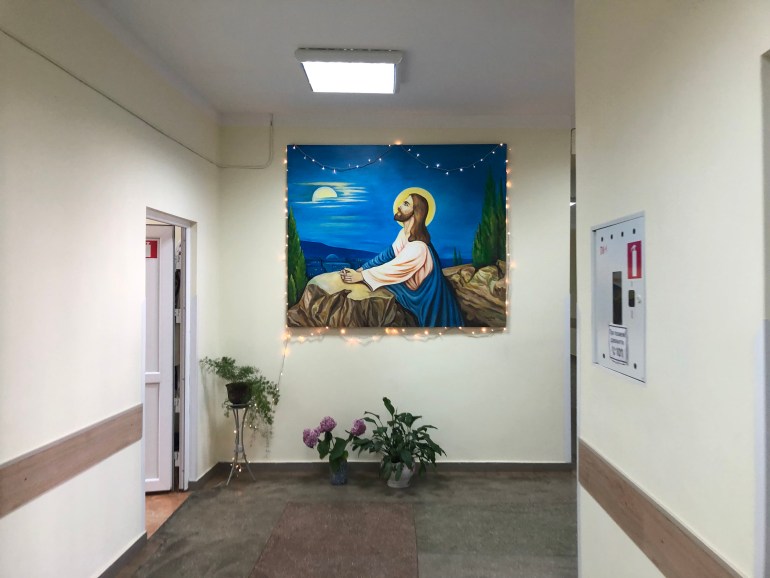
But the walk up to the office of 35-year-old Volodymyr Lykhach is well-lit, with a bright painting of Jesus framed by fairy lights hanging at the end of the corridor.
Originally trained as a psychologist with a private practice, Lykhach decided to take on a role at the state-run hospital when the war started, correctly anticipating that mental health services for military personnel would soon be overwhelmed. “We weren’t prepared for this sort of work,” he says.
“Everything I and my colleagues knew was about how to rehabilitate people after the war. What we’re seeing now is completely different.”
‘Help them endure’
Lykhach makes his rounds in a short-sleeved white doctor’s jacket. A gentle man who speaks thoughtfully, his earnest eyes framed by black glasses, Lykhach knows that the task at hand is becoming more daunting – and critical – as the war shows no sign of ending. The number of his patients fluctuates constantly as they return to the front line or to their hometowns, but he says he averages about 10 to 12 consultations a week, sometimes several will be with the same soldiers. These consultations include strategies aimed at helping soldiers manage trauma.
The nature of new admissions to the hospital is also changing with the use of deadlier, long-range weapons on military and supply bases, ostensibly in response to Ukraine receiving more military aid from allies. “In the beginning, there were many more internally displaced civilians here. Now we get mostly active soldiers,” he says, noting that he has been seeing more cases of severe head injuries.
Some of those patients, Lykhach says, can take four months to recover, while others need a year or more. “We are trying to protect people,” Lykhach says. “But this is a mass war with a huge front line, not a local conflict. There may be errors.”
He does not know how many of the soldiers he has treated have returned to war.
The dilemma he struggles with the most is the need to prioritise the interests of the state while caring for an individual. “This war is about our survival. There are people who are not motivated to fight, but they need to. They say that they don’t want to see the things they saw any more. But our main job is to help them endure. I’m trying my best to prevent lasting trauma, and to give them the ability to care for themselves,” Lykhach says.
According to Taras Klofa, a recently-retired colonel and military doctor in Lviv who has treated soldiers with severe injuries since the conflict in Donbas began in 2014, it is “by order of the Ministry of Defense” that injured service members must return to combat if they are deemed to have sufficiently recovered and “capable to serve”.
“We have many soldiers who have very serious disabilities sustained through war, like blindness – and even though they can’t go to the front line, they’re still keen to serve in other ways, and often it is still possible,” Klofa explains.
The Armed Forces of Ukraine said in an email that it was unable to comment at this time on its current protocol for returning injured soldiers who have recovered back to the front line.

All injured soldiers must be cleared by a medical military commission. It decides if a soldier is fit to return to war, needs to be discharged from service due to their injuries, or requires additional leave or treatment.
Some soldiers are determined to back to the front line, regardless of what the commission thinks. “I had a patient who recovered from a severe head injury,” says Lykhach, referring to a soldier who was treated for three months. “They [the army] wanted to write him off, but somehow he recovered and went back to fight.”
He is painfully aware that the pressure to win the war means that his patients’ time for convalescence has a limit. “What we’re doing now usually takes much longer, but we can’t afford to wait. My job is to stabilise their mental condition so they’re able to go back. Full therapy has to come after victory.”
Without a blueprint for how to deal with scores of fatigued soldiers grappling with post-traumatic stress disorder (PTSD), Lykhach and his colleagues have had to consult psychologists from other countries who worked in similar contexts.