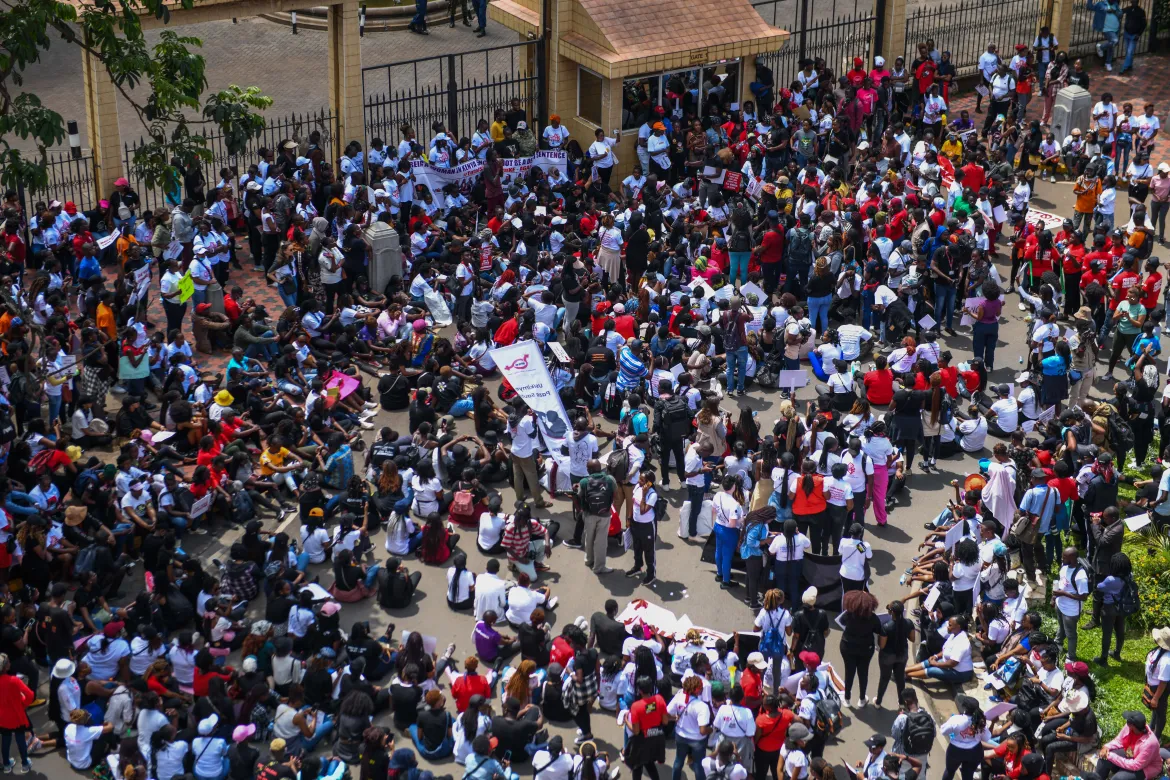
Thousands of people have gathered to protest in cities and towns in Kenya against the recent slayings of more than a dozen women. The anti-femicide demonstration on Saturday was the largest event ever held in the country against sexual and gender-based violence. In the capital, Nairobi, protesters wore T-shirts printed with the names of women who became homicide victims this month. The crowd, composed mostly of women, brought traffic to a standstill. “Stop killing us!” the demonstrators shouted as they waved signs with messages such as “There is no justification to kill women.” The crowd in Nairobi was hostile to attempts by the parliamentary representative for women, Esther Passaris, to address them. Accusing Passaris of remaining silent during the latest wave of killings, protesters shouted her down with chants of “Where were you?” and “Go home!” “A country is judged by not how well it treats its rich people, but how well it takes care of the weak and vulnerable,” said Law Society of Kenya President Eric Theuri, who was among the demonstrators. Advertisement Kenyan media outlets have reported the slayings of at least 14 women since the start of the year, according to Patricia Andago, a data journalist at media and research firm Odipo Dev who also took part in the march. Odipo Dev reported this week that news accounts showed at least 500 women were killed in acts of femicide from January 2016 to December 2023. Many more cases go unreported, Andago said. Two cases that gripped Kenya this month involved two women who were killed at Airbnb accommodations. The second victim was a university student who was dismembered and decapitated after she reportedly was kidnapped for ransom. Theuri said cases of gender-based violence take too long to be heard in Kenyan court, which he thinks emboldens perpetrators to commit crimes against women. Sign up for Al Jazeera Weekly Newsletter The latest news from around the world. Timely. Accurate. Fair. E-mail address Sign up By signing up, you agree to our Privacy Policy protected by reCAPTCHA “As we speak right now, we have a shortage of about 100 judges. We have a shortage of 200 magistrates and adjudicators, and so that means that the wheel of justice grinds slowly as a result of inadequate provisions of resources,” he said. Advertisement People gather to stage a protest against increasing violence against women in the country as they march to the parliamentary building and supreme court in Nairobi, Kenya on January 27 People gather to protest in an anti-femicide demonstration, the largest event of its kind ever held in Kenya. [Gerald Anderson/Anadolu Agency] Advertisement People gather to stage a protest against increasing violence against women in the country as they march to the parliamentary building and supreme court in Nairobi, Kenya on January 27 Kenyan media outlets have reported the slayings of at least 14 women since the start of the year. [Gerald Anderson/Anadolu Agency] A protester holds a Palestinian flag during a procession to protest against the rising cases of femicide, in downtown Nairobi, Kenya Saturday A protester holds a Palestinian flag during a march to protest against the rising cases of femicide, in downtown Nairobi. [Brian Inganga/AP Photo] Women and feminists in Kenya took to the streets to march against the rising cases of femicide, in downtown Nairobi, Kenya, Saturday Women and feminists in Kenya took to the streets to march against the rising cases of femicide. [Brian Inganga/AP Photo] People gather to stage a protest against increasing violence against women in the country as they march to the parliamentary building and supreme court in Nairobi, Kenya on January 27 In Nairobi, protesters wore T-shirts printed with the names of women who became homicide victims this month. [Gerald Anderson/Anadolu Agency] Women and feminists in Kenya react against the rising cases of femicide, in downtown Nairobi, Kenya Saturday, Jan. 27 Protesters react against the rising cases of femicide. [Brian Inganga/AP Photo] Advertisement A human rights activist reacts as she attends a protest demanding an end to femicides in the country in Kenya's capital, Nairobi, January 27 A human rights activist reacts as she attends a protest demanding an end to femicide in the country. [Monicah Mwangi/Reuters] A human rights activist reacts as she attends a protest demanding an end to femicides in the country in Kenya's capital, Nairobi, January 27 Protesters gather during the anti-femicide demonstration. [Gerald Anderson/Anadolu Agency] A human rights activist reacts as she attends a protest demanding an end to femicides in the country in Kenya's capital, Nairobi, January 27 The crowd, composed mostly of women, brought traffic to a standstill. [Gerald Anderson/Anadolu Agency]

Strong family equals strong nation

Story By: Graphic.com.gh

In 1993, the General Assembly of the United Nations decided that May 15 of every year should be observed as The International Day of Families.

The day provides an opportunity to promote awareness of issues relating to families and to increase the knowledge of the social, economic and demographic processes affecting families.

The family is the basic unit of two or more people who are related by blood and share emotional ties.

- Advertisement -

It provides emotional, physical and psychosocial care or protection to its members.

The family is a sanctuary of love — a place where life is nurtured and protected.

It is in the family that we learn the natural things and the values of life.

- Advertisement -

The family’s role in shaping society’s moral fibre is multifaceted and profound.

As the foundational unit of society, families instil values, norms and ethical codes in individuals, contributing to the development of a collective conscience.

This moral framework guides behaviour and interactions within society, maintaining social order and stability.

The family and society are intricately connected, with each playing a vital role in shaping the other.

- Advertisement -

As a fundamental social unit, the family serves as a foundation for societal structure and function.

Conversely, society influences family dynamics, values and relationships.

On one hand, families contribute to society by socialising children, transmitting cultural values and providing emotional support.

Parents and caregivers teach children essential skills, values and norms that enable them to interact effectively within society.

Families also foster a sense of belonging and identity, which is crucial for individual well-being and social cohesion.

On the other hand, society significantly influences family dynamics. Societal norms, values and institutions shape family structures, relationships and values.

For instance, cultural attitudes towards marriage, parenting and family roles can either support or challenge traditional family structures.

Additionally, socioeconomic factors, such as poverty, education and employment opportunities, can impact family stability and well-being.

The interplay between family and society is complex and dynamic.

As societies evolve, family structures and relationships adapt to changing circumstances.

For example, urbanisation and modernisation have led to increased nuclear family structures and changing roles within families.

Understanding the relationship between family and society is essential for promoting healthy family dynamics and building stronger communities.

By recognising the interconnectedness of family and society, policymakers, educators and community leaders can develop initiatives that support families and foster positive social change.

Ultimately, the family-society relationship is reciprocal, with each influencing the other in profound ways. By nurturing strong families and supportive communities, we can build a more compassionate and resilient society for future generations.

The Ghanaian family, once a bastion of strength and unity, is facing numerous challenges that threaten its very fabric.

The traditional extended family system, which provided a support network for its members, is eroding due to modernisation and urbanisation.

This breakdown has led to a loss of cultural heritage and traditional values, leaving many families without a sense of direction and purpose.

Poverty and unemployment are also significant issues affecting our families.

Many households struggle to make ends meet, with limited access to resources and opportunities.

This economic strain can lead to stress, anxiety and depression, further exacerbating family woes.

Furthermore, Ghanaian families are not immune to the challenges of modern life, including domestic violence, substance abuse and mental health issues.

These problems can have devastating consequences for family members, particularly children, who may experience long-term emotional and psychological trauma.

To address these critical issues, it is essential to implement comprehensive solutions that prioritise family support and empowerment.

This can include initiatives such as economic empowerment programmes, education and skills training, and family counselling services.

Additionally, efforts to preserve traditional values and cultural heritage can help strengthen family bonds and promote unity.

Ultimately, the Ghanaian family requires a multifaceted approach to address the complex challenges it faces.

As a people, by working together to support families and promote their well-being, we can build a stronger, more resilient society for future generations.

This is a charge to the state, inter-faith organisations, civil society groups, political, traditional and community leaders.

 

Share This Article
Leave a Comment

Leave a Reply

Your email address will not be published. Required fields are marked *