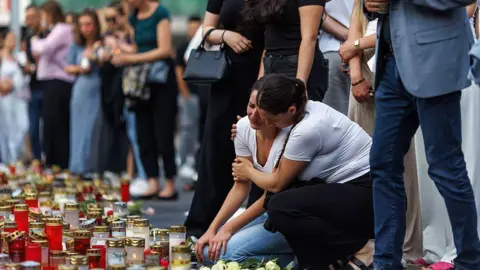
Two shocking attacks within two hours of each other, in France and Austria, have left parents and governments reeling and at a loss how to protect school students from random, deadly violence.
At about 08:15 on Tuesday, a 14-year-old boy from an ordinary family in Nogent, eastern France, drew out a kitchen knife during a school bag check and fatally stabbed a school assistant.
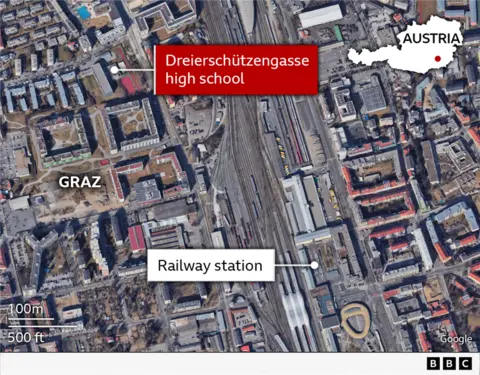
Not long afterwards in south-east Austria, a 21-year-old who had dropped out of school three years earlier, walked into Dreierschützengasse high school in Graz at 09:43, and shot dead nine students and a teacher with a Glock 19 handgun and a sawn-off shotgun.
In both countries there is a demand for solutions and for a greater focus on young people who resort to such violence.
Austria has never seen a school attack on this scale, but the French stabbing took place during a government programme aimed at tackling the growth in knife crime.
Austrians ask about gun laws and a failed system
The Graz shooter, named by Austrian media as Arthur A, has been described by police as a very introverted person, who had retreated to the virtual world.
His “great passion” was online first-person shooter games, and he had social contacts with other gamers over the internet, according to Michael Lohnegger, the criminal investigation chief in Styria, the state where it happened.
A former student at the Dreierschützengasse school, Arthur A had failed to complete his studies.
Arriving at the school, he put on a headset and shooting glasses, before going on a deadly seven-minute shooting spree. He then killed himself in a school bathroom.
He owned the two guns legally, had passed a psychological test to own a licence and had several sessions of weapons training earlier this year at a Graz shooting club.
This has sparked a big debate in Austria about whether its gun laws need to be tightened – and about the level of care available for troubled young people.
It has emerged that the shooter was rejected from the country’s compulsory military service in July 2021.
Defence ministry spokesman Michael Bauer told the BBC that Arthur A was found to be “psychologically unfit” for service after he underwent tests. But he said Austria’s legal system prevented the army from passing on the results of such tests.
There are now calls for that law to be changed.
Alex, the mother of a 17-year-old boy who survived the shooting, told the BBC that more should have been done to prevent people like Arthur A from dropping out of school in the first place.
“We know… that when people shoot each other like this, it’s mostly when they feel alone and drop out and be outside. And we don’t know how to get them back in, into society, into the groups, into their peer groups,” she said.
“We, as grown-ups, have got the responsibility for that, and we have to take it now.”
President Alexander Van der Bellen raised the possibility of tightening Austria’s gun laws, on a visit to Graz after the attack: “If we come to the conclusion that Austria’s gun laws need to be changed to ensure greater safety, then we will do so.”
Austria has one of the most heavily armed civilian populations in Europe, with an estimated 30 firearms per 100 people.
Although there have been school shootings here before, they have been far smaller and involved far fewer casualties.
The mayor of Graz, Elke Kahr, believes no private person should be able to have weapons at all. “Weapons licences are issued too quickly,” she told Austria’s ORF TV. “Only the police should carry weapons, not private individuals.”