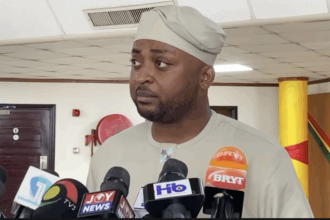
A senior research associate at Imani Centre for Policy and Education, Dennis Asare, has emphasized the need to minimize the discrimination and exclusion women face when accessing land.
“After almost three decades of land reforms in this country, we still see a lot of exclusion and discrimination that women encounter in accessing land,” he explained.
Mr. Asare made the statement at an event in collaboration with Atlas Network on the “Benefits to Women of Increased Access to Land,” project.
The project was part of a programme to minimize poverty where they explore innovative solutions at the community level that contribute to increasing women’s enterprise or broadly enhancing the abilities of people and how that comes together to reduce poverty.
He noted that about 25 percent of women in the agriculture household were able to own land.
“If we don’t advocate an increase for women’s access to land, then our efforts to minimize poverty will not benefit everybody,” he added.
He said women were known to take care of household food, child care, and other activities and that to be able to effectively perform those functions women needed economic resources, adding that “in rural areas, the most important economic resources to women island”.
Collaboration
The Managing Partner of Ampofo, Oppong, and Associates, Lawyer Yaw D. Oppong, suggested that women in farming, especially in the northern region, should form cooperatives when dealing with banks in issues of finance.
“Most banks will be more comfortable in dealing with cooperatives than with my poor old mother, who has one acre of cocoa and so on,” he explained.
Documentary
A documentary titled “No Woman’s Land” composed by Imani and Atlas Network sought to elucidate the challenges women go through in accessing land in the northern region.
The agriculture sector is the driver of growth in the economy contributing about 20 percent of gross domestic product (GDP) and an average growth of 4.9 percent.
In rural areas, about seven out of every 10 people are engaged in agriculture, making it the main income-generating activity.
Despite these opportunities and prospects of the agricultural sector, access to secure land, a critical resource is unevenly distributed as women face varying forms of discrimination in accessing land, particularly in the northern part of Ghana.
Women acquire land through their husbands, allocating pieces of land for farming or acquiring communal lands through a male or an elder of the community.
Section 11 of the new Lands Act 2020, prohibits any acts or practices that discriminate access to land on grounds of gender.
At the end of filming the documentary, Imani signed a memorandum of understanding (MOU) between the Chief of Dimabi Community, Danaa Mohammed and Borinmang Noo Kumya Women’s Group for a 10-acre land to farm for a period of 10 years.