
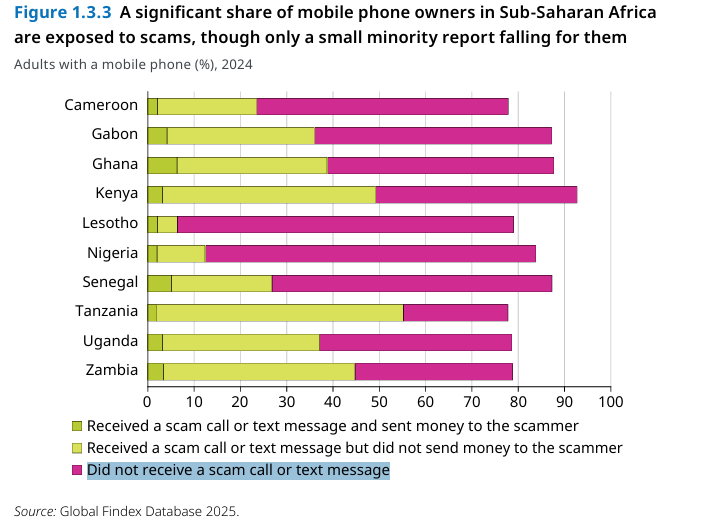
Nearly 8% of mobile phone users in Ghana have reported receiving scam calls or text messages and ultimately sending money to fraudsters, according to the 2025 Global Findex Report released by the World Bank.
The report further reveals that 32% of Ghanaian mobile users also received scam messages or calls, but managed not to send money. Meanwhile, 48% of users said they had not received any such scam communication during the reporting period.
The World Bank report explains that across several countries—including Ghana, Gabon, and Senegal—there is both a high level of exposure to digital scams and a relatively high likelihood of victims sending money.
The data was collected through the Global Findex 2025 Digital Connectivity Tracker, which explores the growing risks associated with digital and financial inclusion.
Interestingly, the report found no significant gender gap in scam exposure or vulnerability: women are not more likely than men to receive scam messages or fall for them.
However, the report emphasised that digital literacy and targeted awareness campaigns are key to prevention.
For example, a study in Uganda showed that using interactive voice response games to educate people about fraud significantly reduced the number of men and women who fell victim to scams.
Despite relatively low global exposure rates, the report stresses that any instance of digital harassment or financial exploitation is unacceptable.
It urges the development of strong legal frameworks that treat online harassment with the same seriousness as physical threats. Notably, only 53 of the 190 countries studied currently impose criminal penalties for cyber harassment offences.
The World Bank is advocating for comprehensive digital literacy programs tailored to vulnerable groups, especially women, adolescent girls, and marginalised communities, to build their capacity to identify scams, protect personal data, and avoid exploitation.
Additionally, it recommends establishing accessible, confidential, and transparent reporting systems to allow victims to report scams without fear of stigma or retaliation.