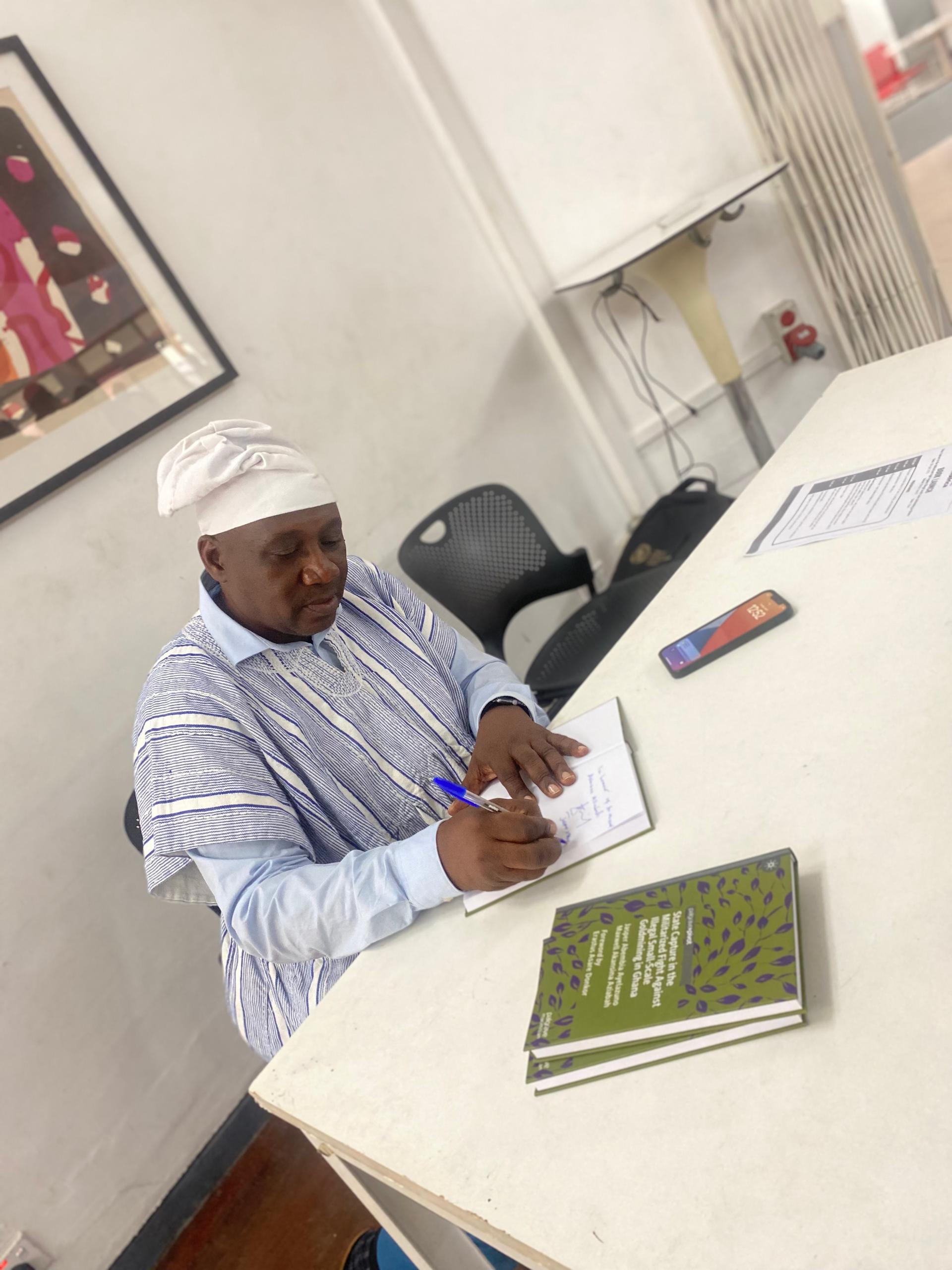
Professor Jasper Abembia Ayelazuno, the Dean of Communication at the University for Development Studies (UDS), has proudly launched a significant new book that he co-authored with the late Dr. Maxwell Akansina Aziabah.
The book, titled “State Capture in the Militarized Fight Against Illegal Small-Scale Gold Mining in Ghana,” addresses critical issues surrounding this pressing topic.
The book, launched at the British Council, Accra, on July 8, 2025, with support from the Third World Network-Africa (TWN-Africa), highlights the devastating nature of illegal mining in Ghana.
The event brought together renowned academics, policymakers, and industry experts to discuss the critical issues surrounding state capture and the militarization of the fight against illegal small-scale mining, popularly known as galamsey.
Reviewed by Prof. Abdulai Abdul Gafaru, the 204-page book provides a comprehensive analysis of the complex relationships between state institutions, military actors, and the galamsey industry.
Through meticulous research and compelling arguments, the authors shed light on how state capture has enabled the proliferation of illegal small-scale gold mining in Ghana.
In his opening remarks, Prof. Abembia Ayelazuno said, “For years, the Ghanaian state has introduced a range of interventions, ostensibly aimed at sanitising the ASM sector of criminal networks and curbing the sector’s devastating environmental and social consequences”.
“These efforts have included the deployment of soldiers, the enactment of new mining regulations, the seizure and destruction of excavators, and what appears, on the surface, to be a firm commitment by the political elite to combat the galamsey menace and protect the environment. Yet, despite these high-profile initiatives, the crisis has only deepened”.
He added, “Ghana’s rivers, including the Pra, Ankobra, Offin, Densu, Birim, and Tano, remain contaminated with mercury and other toxic chemicals, the result of unchecked illegal mining that continues to threaten the health, livelihoods, and water security of millions”.
He further recommended in the book that the incumbent government should dismantle the power structures that protect and benefit from illegal mining.
He also suggested that the government should declare a state of emergency in the mining-affected areas.
“Such a declaration would have been a powerful political signal, a sign of seriousness and a first step toward disrupting the informal power networks that have captured the state,” he noted.