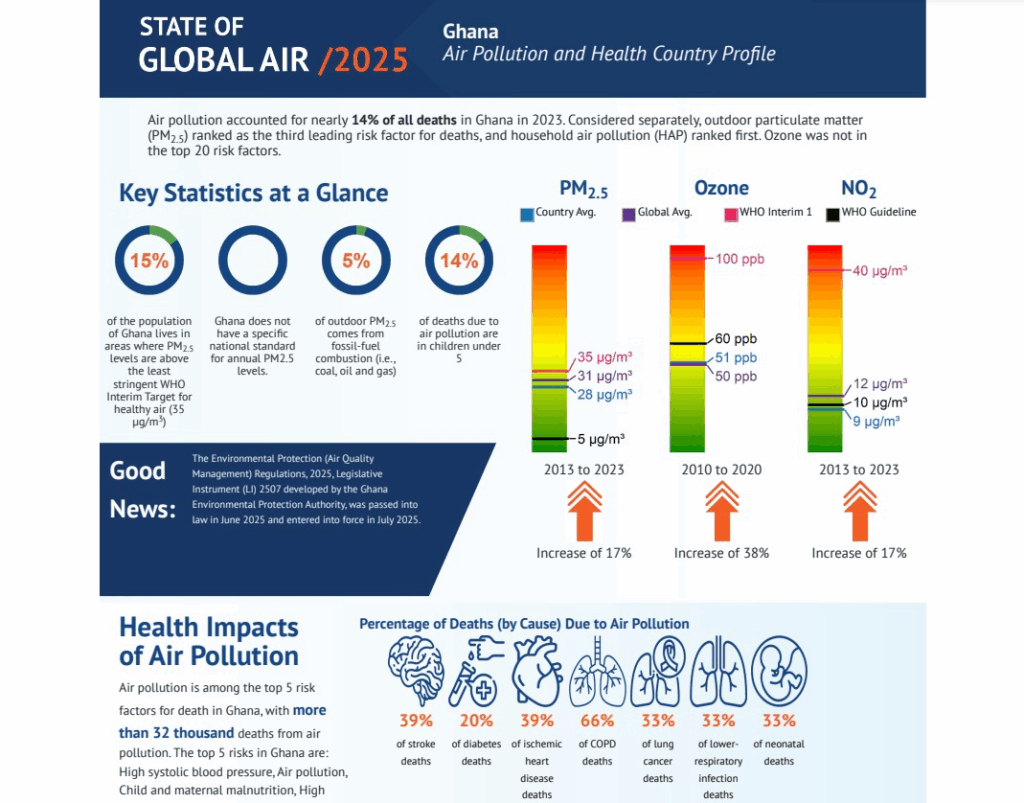
Air pollution has become one of Ghana’s deadliest public health threats, claiming more than 32,000 lives in 2023, according to the State of Global Air 2025 report.
The study, produced by the Health Effects Institute (HEI) and the Institute for Health Metrics and Evaluation (IHME), shows that polluted air was responsible for nearly 14 percent of all deaths in Ghana last year, making it the second leading cause of death after high blood pressure.
Back in 2019, the World Health Organization (WHO) estimated that around 28,000 Ghanaians died each year from air pollution.
By 2025, that figure had risen by more than 4,000 deaths, revealing a deeply troubling trend.
The Air Quality Life Index (AQLI) 2025 report also warns that dirty air is cutting the average Ghanaian’s life expectancy by about 0.8 years, or roughly nine months.
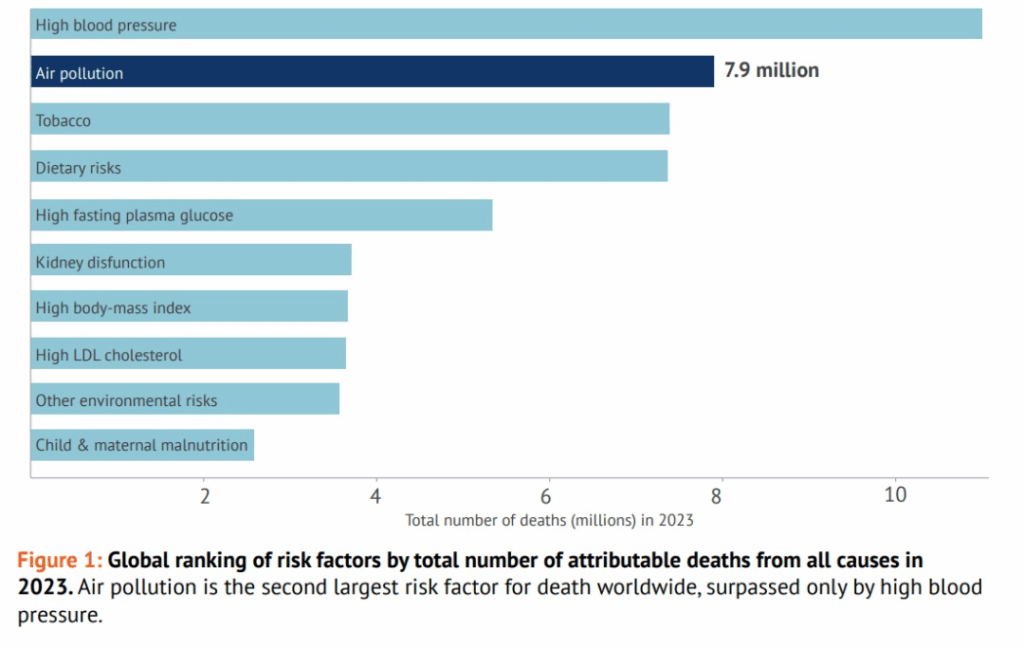
Although global air pollution deaths hover around 7.9 million, Ghana’s share is disproportionately high.
The country’s death rate of 177 per 100,000 people is more than ten times higher than in high-income nations.
Among the victims, about 5,900 were children under 20, highlighting the devastating toll on Ghana’s youngest and most vulnerable citizens.
Air pollution is now linked to one in three heart disease deaths in Ghana.
It also drives two-thirds of COPD deaths, one in five diabetes deaths, and a third of lung cancer deaths, as well as many neonatal and respiratory infections.
The main culprit is household air pollution from burning wood, charcoal, and other solid fuels, responsible for 71 percent of pollution-related deaths.
The rest comes from outdoor particulate matter (PM2.5), mainly vehicle emissions, industrial pollution, and waste burning.
Ghana’s annual PM2.5 concentration averages 28 µg/m³, lower than the WHO’s interim target of 35 µg/m³, but nearly six times higher than the safe guideline of 5 µg/m³.
Pollution levels have risen by 17 percent since 2013, reflecting worsening urban air quality despite growing public concern.
Other pollutants are also on the rise.
Ghana’s annual averages are 51 ppb for ozone and 9 µg/m³ for nitrogen dioxide, both close to global levels but increasing steadily.
Major outdoor pollution sources include residential emissions, agriculture, energy production, and industrial activity.
Despite the worsening crisis, Ghana only recently introduced a comprehensive legal framework to tackle the problem.
In June 2025, the country passed the Environmental Protection (Air Quality Management) Regulations, 2025 (L.I. 2507), which took effect in July.
The law empowers the Environmental Protection Agency (EPA) to set emission limits, monitor air quality, and penalise polluters.
However, Ghana still lacks a national standard for annual PM2.5 levels, a key benchmark for cleaner air.
The 2024 State of Global Air report, based on 2021 data, estimated 8.1 million global deaths from air pollution, with Africa and South Asia bearing the highest burden.
At that time, Ghana’s air pollution deaths stood at 28,000, meaning the country had recorded a surge of more than 4,000 deaths in just two years.
Experts warn that without urgent action, air pollution could derail Ghana’s health and development goals.
Around 5 percent of outdoor particulate pollution comes from fossil fuels, a figure expected to rise as energy demand and vehicle imports grow.
Air pollution now ranks among Ghana’s top five causes of death, alongside high blood pressure, malnutrition, and poor diet.
For millions of households, the lack of access to clean cooking fuels, sustainable livelihoods, and proper waste management continues to fuel the crisis.
Without stronger air quality standards, clean energy investments, and strict enforcement, thousands more Ghanaians will keep dying each year simply for breathing.