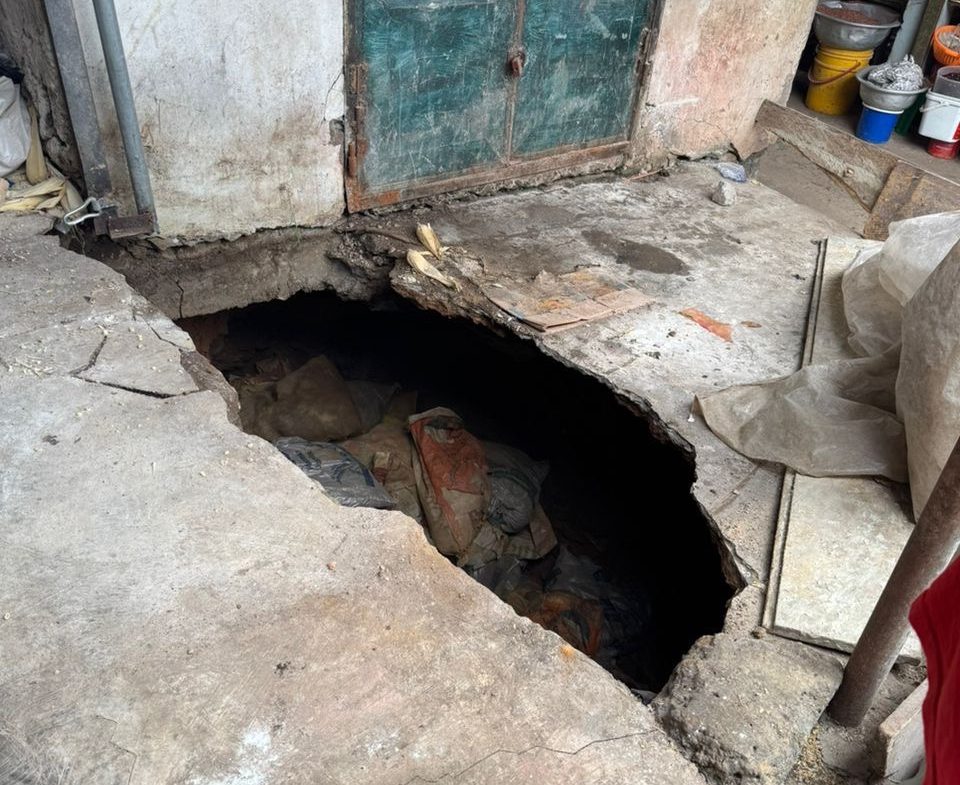
A quiet Monday morning at Tarkwa’s Women Market turned unsettling when traders discovered that the frontage of two shops had caved in overnight.
The collapse left a deep, gaping hole, serving as another stark reminder of the growing risk beneath one of Ghana’s most heavily mined towns.
The shops, located at Mbesiafo Gua Mu, are now exposed at their base, the hole stretching ominously toward nearby stalls.
Thankfully, no one was injured, and business resumed shortly after, but fear hung in the air.
Despite the visible danger, the affected shop owners reopened and continued selling, anxious that the damage might scare away customers.
Nearby traders shifted goods to safer areas, shaken but relieved that the incident hadn’t happened during market hours.
Tarkwa’s landscape has been ravaged by decades of mining, from colonial operations to today’s mix of industrial and artisanal extraction.
These activities have created a fragile foundation beneath homes, markets, and roads.
In 2021, a galamsey pit collapse near Bonsawire claimed seven lives. In 2023, a similar incident occurred at the Tarkwa Community Mine.
Studies from the University of Mines and Technology and the Ghana Geological Survey Authority confirm that parts of Tarkwa are vulnerable to land subsidence.
Experts are calling for urgent and expanded geophysical mapping to prevent future disasters.