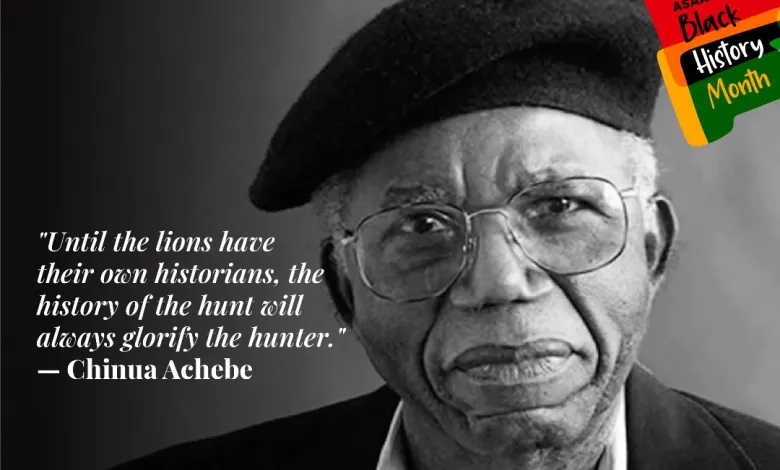
For decades, Africa’s stories were told through the eyes of outsiders—narratives that often misrepresented its people, cultures, and history.
Then came Chinua Achebe, a literary giant who reshaped global perceptions of Africa through his groundbreaking work.
Widely hailed as the father of modern African literature, Achebe’s influence extends beyond storytelling—his voice became a powerful force in reclaiming African identity and dignity.
Born in 1930 in Ogidi, Nigeria, Achebe grew up witnessing the collision of traditional Igbo customs with British colonial rule. This duality would later inform his writing, particularly his most famous novel, Things Fall Apart (1958).
The book, which has been translated into more than 50 languages and sold over 20 million copies, dismantled the Eurocentric portrayal of Africa and introduced a nuanced, authentic African perspective to the world.
At the heart of Things Fall Apart is Okonkwo, a proud Igbo leader whose life unravels with the arrival of colonial forces. Through this deeply human story, Achebe highlighted the richness of African traditions, the complexities of pre-colonial societies, and the devastating impact of European imperialism.
The novel was groundbreaking, not just for its content but also for its language. Achebe blended English with Igbo expressions, proverbs, and oral storytelling techniques, proving that African stories could be told on their own terms without losing authenticity.
Beyond Things Fall Apart, Achebe continued to challenge colonial and post-colonial narratives with books like No Longer at Ease, Arrow of God, A Man of the People, and Anthills of the Savannah. His essays, particularly The Trouble with Nigeria, offered sharp critiques of political corruption and leadership failures in post-independence Africa. Achebe’s belief in the power of literature to effect change was evident in his commitment to mentoring young writers and editing publications that championed African voices.
His influence transcended literature. Achebe was an academic, political thinker, and advocate for African storytelling. His famous critique of Joseph Conrad’s Heart of Darkness, in which he called Conrad a “thoroughgoing racist” for his depiction of Africans, sparked global debates on racism in literature and the ethics of storytelling. His stance forced literary scholars to re-examine how Africa was portrayed in Western literature and challenged them to recognise African perspectives.
Achebe’s legacy continues to inspire generations of African writers, including Chimamanda Ngozi Adichie, Ngũgĩ wa Thiong’o, and Wole Soyinka.
His work laid the foundation for a literary movement that asserts African identity, history, and cultural pride. More than six decades after Things Fall Apart was published, its themes of colonial disruption, resilience, and cultural survival remain as relevant as ever.
In 2013, the world lost Achebe, but his words remain immortal. He gave Africa a literary voice when it was most needed, ensuring that its stories would no longer be told solely from the perspective of the hunter but also from that of the lion.