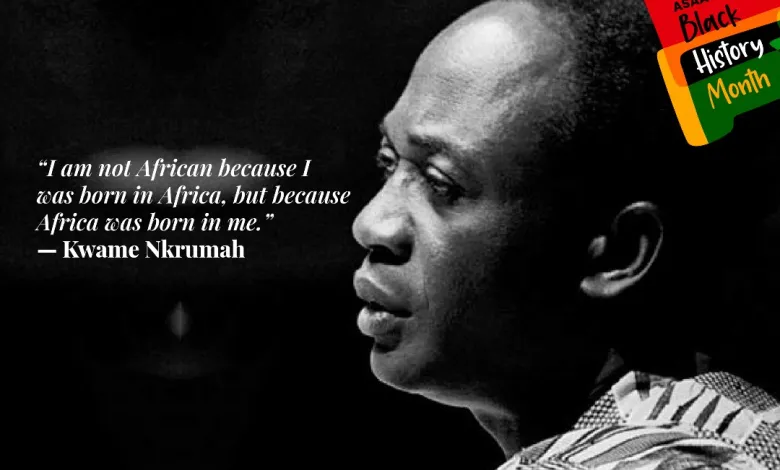
On 6 March 1957, Ghana emerged as the first sub-Saharan African country to break free from colonial rule, and at the helm of this historic moment stood Kwame Nkrumah—a man whose vision extended far beyond the borders of his homeland.
More than just Ghana’s first Prime Minister and later President, Nkrumah was a relentless champion of Pan-Africanism, an architect of unity, and a leader whose ideas continue to shape the African continent decades after his passing.
The Making of a Revolutionary
Born in 1909 in the Gold Coast (now Ghana), Nkrumah’s early exposure to colonial rule ignited a passion for African liberation.
He pursued higher education in the United States and later in the United Kingdom, where he became deeply influenced by the ideas of Marcus Garvey and W.E.B. Du Bois. His time abroad cemented his belief that Africa’s true independence could only be achieved through unity, and he returned home determined to turn that vision into reality.
Ghana’s Independence: A New Dawn for Africa
As the leader of the Convention People’s Party (CPP), Nkrumah’s call for “Self-government now!” resonated with the masses. After years of struggle, Ghana finally gained independence from Britain in 1957. In his victory speech, he declared:
“The independence of Ghana is meaningless unless it is linked up with the total liberation of Africa.”
True to his words, he poured resources into supporting independence movements across Africa, earning him the admiration of many and the suspicion of Western powers.
Pan-Africanism: The Dream of One Africa
Nkrumah believed that African nations, if united, could form a powerful global force. He championed the formation of the Organisation of African Unity (OAU) in 1963, the forerunner of today’s African Union.
His book, Africa Must Unite, laid out his bold ideas for a United States of Africa, a vision that many African leaders still aspire to today.
Downfall and Legacy
Despite his groundbreaking achievements, Nkrumah’s leadership style became increasingly authoritarian. A military coup in 1966 overthrew him while he was on a diplomatic trip to China. He lived the rest of his life in exile in Guinea, where he was given the honorary title of Co-President by President Sékou Touré.
Though he passed away in 1972, Nkrumah’s legacy is deeply woven into Africa’s story. His emphasis on education, industrialisation, and continental unity remains relevant today. The Kwame Nkrumah Mausoleum in Accra stands as a tribute to his dream of a free and united Africa.
Why Kwame Nkrumah still matters
In an era where Africa is still grappling with economic dependencies, neocolonialism, and fragmented leadership, Nkrumah’s call for unity echoes louder than ever. His belief in African solutions for African problems is a blueprint that modern leaders must revisit.
As we celebrate Black History Month, let us remember that Nkrumah was not just Ghana’s leader—he was a torchbearer for the entire continent. His words and actions continue to inspire a new generation of Africans to rise, unite, and redefine their destiny.
By Jimmy Kutin