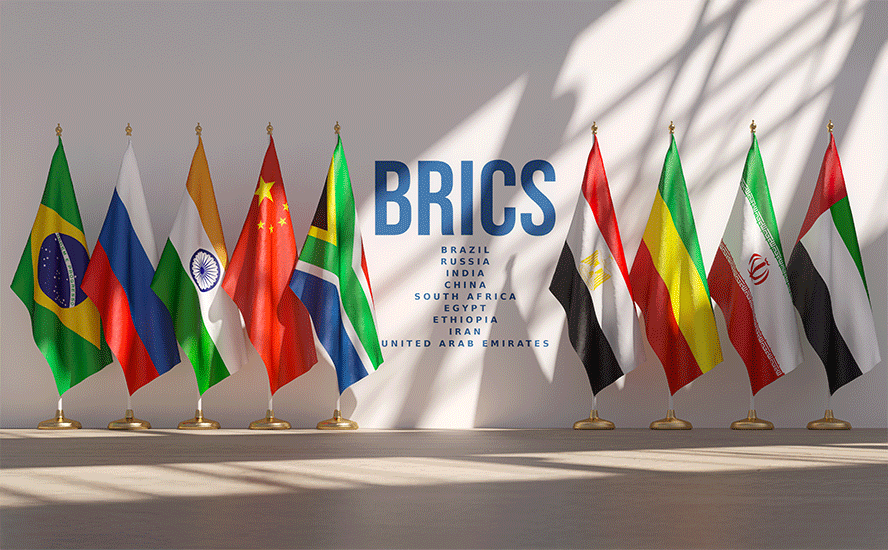
Emerging powers, particularly the BRICS nations (Brazil, Russia, India, China, and South Africa), have transformed from impoverished countries to economic and political powerhouses within a relatively short period.
The rise of these nations presents a counter-hegemonic force in global politics, challenging the unipolarity that existed after the Cold War and the collapse of the Soviet
Union. This shift has significant implications for global governance, economic development, and
international relations.
The BRICS countries have achieved remarkable economic growth, lifting millions of people out of
poverty and transforming their societies. China, for instance, has become the world’s second-largest
economy, with a GDP of over $14trillion. India has also experienced rapid economic growth, with
its GDP exceeding $2.7 trillion. Brazil, Russia, and South Africa have also made significant
economic strides, driven by their vast natural resources, large markets, and strategic locations.
The rise of the BRICS nations has challenged the dominance of Western powers, particularly the
United States, in global affairs. Until recently, the United States was the sole superpower, and its
influence was unparalleled. However, the emergence of BRICS countries has provided a
counterbalance to American dominance, offering alternative policies and approaches. The
Washington Consensus, which promoted American-style capitalism, is no longer the only
economic model. The Beijing Consensus, driven by China’s economic success, has emerged as a
viable alternative.
The Beijing Consensus emphasizes state-led development, investment in infrastructure, and a more
gradual approach to economic liberalization. This approach has attracted many developing
countries, which are seeking alternatives to the Washington Consensus. The Beijing Consensus has
also led to the establishment of new institutions, such as the BRICS Development Bank and the
Asian Infrastructure Investment Bank (AIIB). These institutions provide alternative sources of
funding for development projects, reducing dependence on Western-dominated institutions like the
WorldBankandtheInternational Monetary Fund (IMF).
China’s growing influence has changed the global landscape, providing developing countries with
alternatives to Western aid and conditionalities. Western countries can no longer dictate terms to
developing nations, as they now have options. China’s more flexible approach has attracted many
developing countries, forcing Western nations to reevaluate their strategies. For instance, China’s
Belt and Road Initiative (BRI) has invested heavily in infrastructure development across Asia,
Africa, and Europe, providing new opportunities for economic growth and cooperation.
The BRI has also led to the establishment of new trade routes, enhancing connectivity between
China and other regions. This initiative has the potential to transform the global economy, creating
new opportunities for trade, investment, and economic growth. However, the BRI has also raised
concerns about China’s growing influence and the potential for debt trap diplomacy.
The rise of emerging powers has also facilitated South-South cooperation, enabling countries in the
Global South to collaborate more effectively. This cooperation has led to the establishment of new
institutions, such as the BRICS Development Bank and the AIIB. These institutions provide
alternative sources of funding for development projects, reducing dependence on
Western-dominated institutions.
South-South cooperation has also led to the sharing of knowledge, expertise, and best practices
among developing countries. This cooperation has the potential to accelerate economic growth,
reduce poverty, and improve living standards in the Global South. However, South-South
cooperation also poses challenges, such as the need for coordination, the risk of competition, and
the potential for unequal relationships.
However, there is a danger that these emerging powers may replicate the exploitative practices of
Western countries. China, for instance, is not a paragon of good governance, and its authoritarian
regime raises concerns. China’s investments in Africa have been criticized for lacking transparency
and perpetuating unequal relationships. Similarly, India’s growing influence in the region has raised
concerns about its impact on local economies and environments.
In conclusion, the emergence of BRICS nations is a double-edged sword. While it provides a
counterbalance to Western dominance and offers alternative policies, it also poses risks, such as the
potential for exploitation and authoritarianism. As these emerging powers continue to grow and
exert their influence, it is essential to monitor their actions and ensure that they promote sustainable
and equitable development.
The rise of emerging powers presents significant challenges for Western nations, necessitating a
reassessment of their strategies to engage effectively with these new global players. Western
countries must adapt to the evolving international landscape by fostering cooperation on pressing
global issues. This shift is a crucial reminder for them to acknowledge the changing dynamics and
respond accordingly.
Ultimately, the rise of BRICS nations offers avenues for collaboration and mutual advantage. As
these emerging powers expand their influence, it becomes vital to encourage dialogue, promote
understanding, and enhance cooperation. This approach will help ensure that the growth of
emerging powers benefits all countries and contributes to a more equitable and sustainable global
order.
Email: Gilbertattipoe90@gmail.com