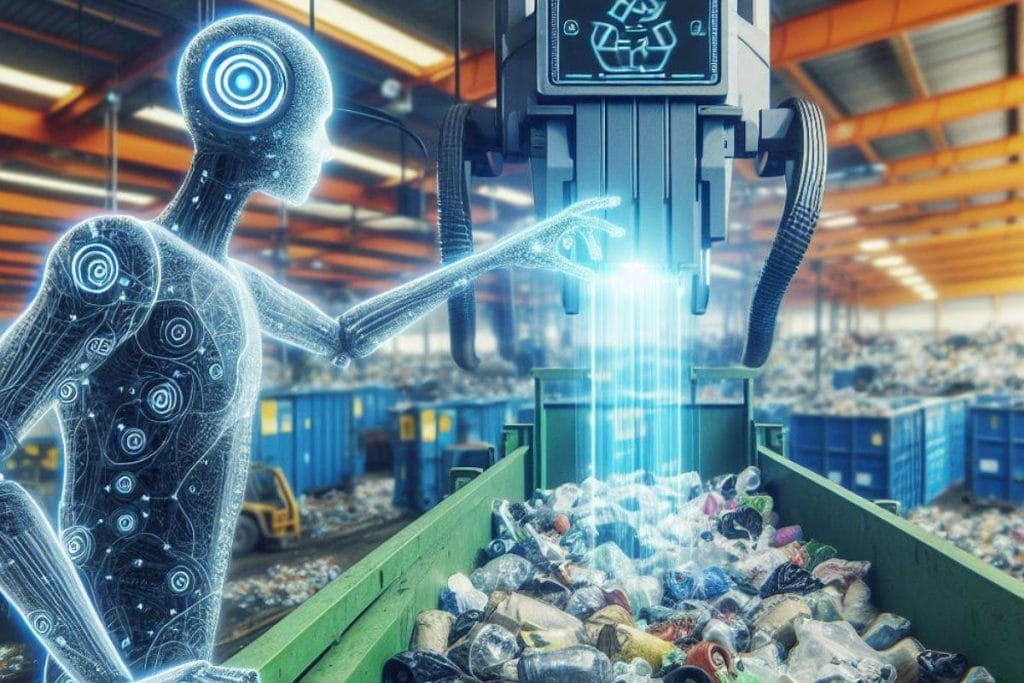
Waste has alarmingly increased globally in recent years, posing serious problems for resource management and environmental sustainability.
Traditional waste management techniques are frequently ineffective and unable to handle the constantly expanding waste streams.
To address these urgent problems, there is new promise for transforming waste management procedures with the advent of Artificial Intelligence (AI) technologies.
According to World Bank report on September 20, 2018, global waste generation, propelled by continuous urbanisation, economic development and an increase in population was estimated at 2.01 billion tons per annum in 2016, and expected to jump to 3.4 billion tonnes over the next 30 years, up from 2.01 billion tonnes in 2016.
This represents an increase of 54.62 per cent from the generation rate of 1.3 billion tons per annum in 2012, and by 70 per cent on current levels by 2050.
Creative ways
AI provides creative ways to improve waste collecting, sorting, recycling and general waste disposal procedures because of its capacity to analyse enormous volumes of data and identify patterns.
Creative uses of AI technologies in waste collection, sorting, recycling and overall waste optimisation, with the goal of transforming waste to energy, and using waste management systems for improved sustainability, resource efficiency and environmental preservation, are available now.
Predictive analytics are also being employed to optimise collection routes, leading to more efficient resource allocation and collection processes.
The framework for predictive waste management using AI includes:
Sensing, smart bin system: This is the stage where smart bins leverage technology by incorporating sensors that monitor waste level in real-time.
This data is transmitted to waste collection schedules and route based on actual needs rather than fixed schedules.
Route optimisation: It is the process of designing the most cost and time effective delivery route by considering multiple parameters, including the vehicle type, driver schedule, delivery time window, delivery location and more.
Waste sorting: Waste sorting is the process by which waste is separated into different elements or automatically separated in materials recovery facilities or mechanical biological treatment systems or robotic system.
Machine learning algorithms: Machine learning algorithms are good at modelling complex nonlinear processes and have been gradually adopted to promote municipal solid waste management (MSWM) and help the sustainable development of the environment in the past few years, for example, Artificial Neural Networks (ANNs).
Analytical prediction: Analytical Prediction is the use of data to predict future trends and events. It uses historical data to forecast potential scenarios that can help drive strategic decisions.