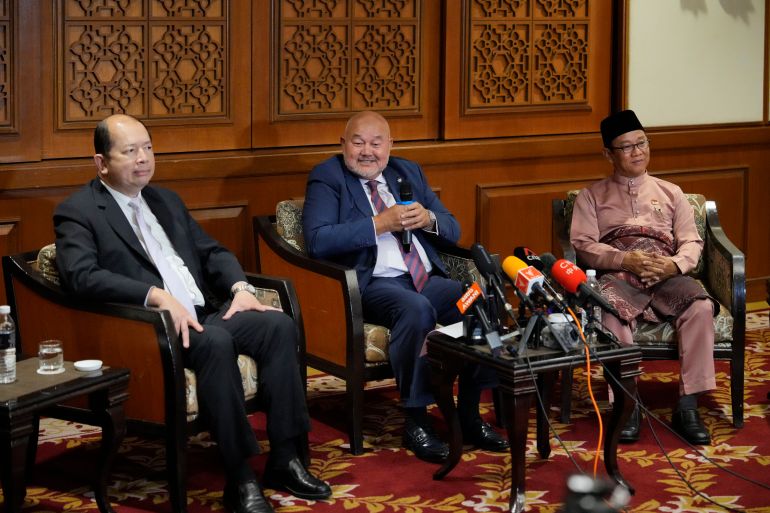
Thailand’s government and Muslim separatist rebels in the country’s south have agreed “in principle” on an updated roadmap to try to end decades-long fighting.
Malaysian facilitator Zulkifli Zainal Abidin told reporters on Wednesday that both sides have agreed in principle to an “improved” peace plan.
“It is a major breakthrough after the dialogue was stalled the past year due to the Thai election,” he said.
The sides held two days of talks in the Malaysian capital, Kuala Lumpur, and will meet again over the next two months to iron out details of the plan. They hope to agree to a ceasefire covering the Muslim fasting month of Ramadan, which starts on March 10, and the Thai festival of Songkran in mid-April.
Malaysia has hosted and facilitated talks between separatist groups and the Thai government since 2013, but little progress has been made.
“The [peace plan], if the technical teams agree, will be signed as soon as possible. … There is light at the end of the tunnel. Both parties are willing to put pen to paper. Previously, there was no talk of signing any documents,” the facilitator said.
More than 7,000 people have died in the violence in Thailand’s largely ethnic Malay, and Muslim provinces of Yala, Pattani and Narathiwat since 2004.
The population of the provinces, which belonged to an independent Malay, Muslim sultanate before Thailand annexed them in 1909, is 80 per cent Muslim while the rest of the country is overwhelmingly Buddhist.

The fighting is intermittent but brutal with the separatists carrying out drive-by shootings and bombings. Malay Muslims accuse security forces of routine abuses, including prolonged and arbitrary detentions without charge as well as extrajudicial killings.
Southern Thai Muslims – whose ethnicity, culture and language differ from the Buddhist majority – believe they are treated as second-class citizens and have the sympathy of many Malaysians, about 60 per cent of whom are Muslim.
Anas Abdulrahman – the head of the Barisan Revolusi Nasional Melayu Patani, the largest of the separatist groups – told reporters that he has high hopes for a lasting solution under the new Thai government, led by Prime Minister Srettha Thavisin.
The Thai government last year appointed Chatchai Bangchuad, the first civilian to head the talks.
Chatchai said any signing of the peace plan depends on the outcome of the technical discussions.